Newsletter

CALL FOR CONSULTANCY SERVICES: Development of a Continental Early Childhood Education and Development (ECED) Framework for Africa

TERMS OF REFERENCE (ToR)

Background and Rational: Early Childhood Education and Development (ECED) is widely recognized as the foundation for lifelong learning, human capital development, and socio-economic transformation. Evidence consistently demonstrates that investments in early childhood yield some of the highest returns in education systems, improving learning outcomes, health, social cohesion, and productivity throughout the life course.  Across Africa, however, access to quality ECED services remains uneven. While several Member States have adopted national early childhood policies and programmes, significant disparities persist in access, quality, financing, teacher preparation, curriculum standards, and governance structures. Many countries also face challenges related to:

  • Fragmented policy frameworks and institutional coordination.

  • Insufficient investment and sustainable financing mechanisms.

  • Limited professional standards and training pathways for ECED educators.

  • Weak monitoring systems and data availability.

  • Inequities affecting children in rural areas, conflict-affected settings, and vulnerable communities.

The Continental Education Strategy for Africa (CESA 2026–2035) recognizes early childhood development as a critical entry point for improving foundational learning and strengthening education systems across the continent. In parallel, the AU Decade of Education and Skills Development (2025–2034) emphasizes building strong learning foundations and strengthening human capital development pathways across the life cycle. In this context, the African Union Commission (AUC), through the Department of Education, Science, Technology and Innovation (ESTI), in collaboration with the African Early Childhood Network (AfECN), seeks to develop a Continental Early Childhood Education and Development (ECED) Framework to guide Member States, Regional Economic Communities (RECs), and partners in strengthening early childhood systems across Africa.

The framework will provide continental policy guidance, standards, and strategic priorities to support Member States in designing and implementing integrated, inclusive, and high-quality ECED systems aligned with CESA 26–35 and Agenda 2063 aspirations.

To support this process, the African Union Commission seeks to engage a qualified consultant (or consultancy firm) to lead the development of the Continental ECED Framework through a consultative and evidence-based process.

Objective of the Consultancy: The overall objective of the consultancy is to develop a comprehensive Continental Early Childhood Education and Development (ECED) Framework for Africa that provides strategic guidance, standards, and implementation pathways to support Member States in strengthening early childhood education systems in alignment with CESA 2026–2035 and the AU Decade of Education and Skills Development (2025–2034).
Global Caregiver Forum 15 - 16 January 2026, CaixaForum, Madrid, Spain

Background

Scientists agree that loving care that makes a child feel loved and secure is a prerequisite for healthy cognitive, emotional, and social development, and the single most important factor for good mental health throughout life. Raising children is perhaps the most important task we undertake, but babies don't come with an instruction manual.

Main Objective

To develop a roadmap for Universal caregiver programs to all who need them worldwide. This event will lay the groundwork for a global summit and a potential United Nations General Assembly resolution on caregiver support.

Evidence-Based

More than four hundred randomized controlled trials, collected in a systematic review led by the WHO in 2022, demonstrate that evidence-based caregiver programs increase nurturing care, reduce maltreatment, and improve parents' mental health outcomes.

Strengthening Primary Health Care to Promote Early Childhood Development

During the first 1,000 days, young children and caregivers have a myriad of touchpoints within the health system. Leveraging these moments to promote nurturing care interventions that are not consistently emphasized in primary health care (PHC) — such as responsive caregiving, safety and security, and opportunities for early learning — can alter their developmental trajectories. This practical global resource aims to support national and sub-national planning for promoting young children’s development in PHC. It highlights opportunities to leverage primary health care platforms and provides concrete examples and guidance for delivering interventions that promote nurturing care for early childhood development.

Promoting nurturing care: How governments are uniting to strengthen ECD in PHC systems

When health officials, civil society representatives and development partners convened in early October for a side event at the Conrad N. Hilton Foundation’s East & Southern Africa Early Childhood Development Partners’ Convening in Nairobi, there was a singular shared goal on everyone’s mind: Ensuring that responsive caregiving, early learning, safety and security, and development monitoring and counseling are prioritized and promoted at scale in primary health care (PHC) systems, alongside health and nutrition interventions.

ADAPTING AND SCALING EARLY LEARNING OUTCOMES ASSESSMENTS IN THE WEST AND CENTRAL AFRICAN REGION

The study provided a comprehensive overview of the existing assessment tools and indicators for early learning quality in sub-Saharan Africa. The review process adhered to the updated guidelines from the Joanna Briggs Institute (JBI) and followed Arksey and O'Malley’s five-step framework. The steps included first specifying the research question, followed by identifying relevant studies, selecting which studies to include, and then extracting, mapping, and charting the data. Finally, the results were collated, summarized, and reported. To ensure methodological rigor, the scoping review aligned with the Preferred Reporting Items for Systematic Review and Meta-Analysis Extensions for Scoping Reviews (PRISMA-ScR) guidelines. Furthermore, the screening of publications for eligibility was guided by the SOCT framework, ensuring a consistent application of inclusion and exclusion criteria throughout the review process.

Act For Early Years

AfECN is a member of the High-Level Advisory Group of the Act For Early Years campaign. This is a global movement working to ensure that every child has access to quality early childhood development, essential to thrive and achieve lifelong well-being. The campaign brings together governments, civil society, donors, businesses and advocates to prioritise investment in the early years as one of the most effective ways to break cycles of poverty and inequality and to build a more equitable world. Act For Early Years is supported by a broad coalition of partners including Theirworld, UNICEF, UNESCO, LEGO Foundation, Dubai Cares, Brookings Institution, ECDAN and many others.

AfECN is actively contributing to enhancing the visibility and uptake of the Act For Early Years campaign across Africa. The network leverages existing regional platforms to integrate the campaign’s key messages into discussions at major events across various sectors. AfECN is also collaborating with key stakeholders to strengthen country-level engagement and to mobilise youth champions for greater advocacy and action in early childhood development.

Find out more and join the campaign at www.actforearlyyears.org.

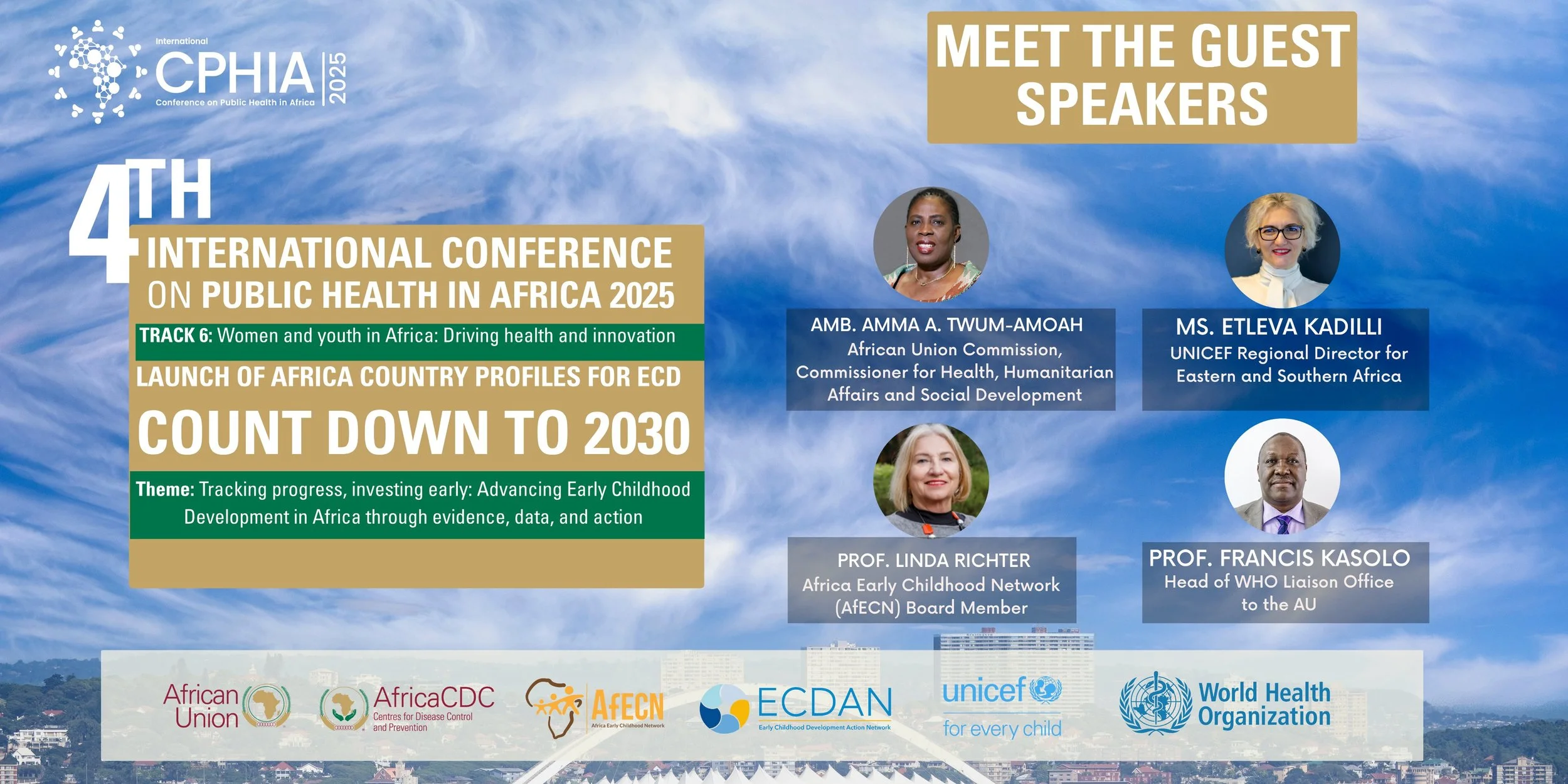
Launch of Africa Country Profiles for ECD Countdown To 2030

The African Union, The African Early Childhood Network, UNICEF, Early Childhood Development Action Network (ECDAN), and World Health Organization (WHO) will launch the Africa ECD Country Profiles Countdown to 2030 during #CPHIA2025.


the Africa ECD Country Profiles Countdown to 2030

Blog 3 | Mitigating the Effects of Extreme Heat on ECDE Centers in Crisis-Affected Northeast Nigeria by Katelin Wilton, Daniel Rotgakka and Fatima Abdulahi

Climate change poses a significant threat to young children in Nigeria, particularly due to extreme heat and increasingly severe floods. Rising temperatures and extreme weather primarily driven by climate change exacerbate the already limited access to safe drinking water, intensifying the risks to children's health and well-being. Young children are also more susceptible to respiratory problems and other heat-related illnesses because their bodies generate more heat relative to their size and they sweat less efficiently.1 High temperatures lead to severe dehydration, heat exhaustion, and heatstroke, which can be life-threatening if not addressed promptly. Overheated classrooms can impair concentration and cognitive function, which in turn impedes learning. The psychological impact of extreme heat includes increased stress and anxiety, which could potentially slow brain development during this most critical developmental window.

ECD AND CLIMATE CHANGE WEBINAR

Join AfECN and partners as we spotlight the intersection of climate change and early childhood development, sharing country findings, lessons, and advocacy entry points to strengthen action for Africa’s youngest.

Date: Wednesday, 24th September 2025

Time: 15:00

Duration: 1hr30Min

Blog 2 | The Silent Crisis: How Climate Change is Threatening Early Childhood Development in Ethiopia by Nebyat Ayele Assefa

Climate change is undermining decades of progress in Ethiopia’s Early Childhood Development (ECD) initiatives. The country is experiencing more frequent droughts, erratic rainfall, and floods, which in turn are exacerbating child malnutrition, increasing the disease burden, disrupting education, and causing psychosocial trauma among young children. This convergence of climate and child development crises represents a national emergency for Ethiopia. Young children (ages 0-5) make up a significant portion of Ethiopia’s population – roughly 13 to 14 million children – and their well-being is inextricably linked to the nation’s future social and economic development. If climate change continues to impair the health and growth of these children, Ethiopia’s aspirations for middle-income status and sustainable development will be gravely threatened. This blog analyzes Ethiopian-specific data on climate change impacts to ECD, reviews current government responses, and outlines recommendations for integrated policies to safeguard the next generation.